 The opportunity to travel and visit Gallaudet University was one I would never have dreamed of being given a year ago. Gallaudet is “the only freestanding institution of higher education in the world designed to meet the specific needs of deaf students (Armstrong).” Essentially, the deaf capital of the world. But not only was I given the opportunity to visit, but stay at the campus for a week, and be fully immersed into the culture by only signing the entire week.
Going into the trip I felt nervous. I had been studying ASL for about six months but I was afraid that I would struggle to communicate with the other students and the individuals who are deaf on campus. I felt as though my vocabulary was quite limited and I did not have many conversational skills. I was also nervous about not using my voice all week. In general, I am always talking and singing, the idea of not speaking for eight days filled me with some apprehension. In our textbook, I learned about Gallaudet. The story of Gallaudet and his meeting of Alice Cogswell and the inspiration behind seeking out a way to communicate with the deaf. The establishment of the school in 1857, the DPN movement in 1988 where the students came together and stood for what they believed in. I learned about the school’s little quirks like the Rat Funeral and the Coffin door, and so much more (Armstrong 53, 159, 105). I was grateful for this history and knowledge as it helped me to feel prepared and truly appreciate the significance of the place I would be visiting and what an amazing and unique opportunity this was.
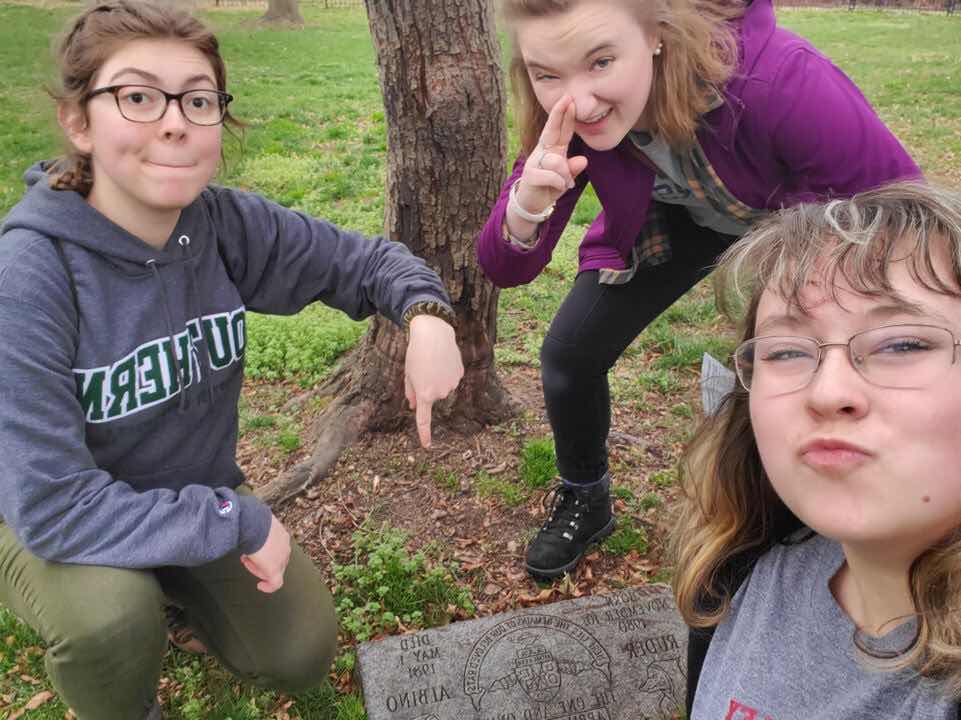 |
| Sam, JG, and I with one of the Rat graves. |
Upon reflecting on my experience at Gallaudet there are a multitude of things that stand out to me, I was tested and taught constantly. I learned about language, culture, history, deaf space, and myself throughout this trip. To begin with, my signing skills and understanding of deaf culture have grown vastly. Every day I learned dozens of new signs, increasing my ability to hold conservations as well as lengthening and deepening my topic range. I found myself moving from conversing about my favorite colors, my family, and what I want to major in, to what I believe as a Christian, the reasons I want to interpret and other topics. It was amazing to feel the change in my signing as my vocabulary grew and as I grew more confident in my experience. Something I believe that really influenced this was our nightly meals at the campus cafeteria. During these times I felt pushed to communicate with those around me, to put myself out of my comfort zone and just simply try, regardless of what mistakes I might make. The students were happy to eat and chat with us, and I was so grateful because they were willing to teach and explain whenever needed. This act on their part was so impactful and helpful for me as a beginner and really helped me to overcome my fear and jump in and communicate with the students.

The vast majority of people at Gallaudet were beyond welcoming and kind. I would completely understand if they were hesitant or confused about our presence, Gallaudet is the place for people who are deaf to gather and have community. A large group of hearing students showing up could easily seem invasive and rude. However, despite that students invited us to their cafeteria tables, were happy to give instructions during our scavenger hunt and were so welcoming and kind. It shows me that there is still kindness in the world and helped me to feel more at ease and excited as I was already nervous to begin with. Their patience with my signing and acceptance of our presence helped me to be more confident and be myself. Deaf and hard of hearing people are just regular people like you and me. They go to school, they go to church, they laugh together over lunch, they stress about studies, they hang out in the park and at coffee shops and they take pride in who they are. Too often people that are “different” then ourselves are viewed as inferior or less then, this is completely untrue. And it was really awesome to see this assumption proved wrong everywhere at Gallaudet.
 |
| A photo taken during the Deaf President Now Movement. |
One thing that became inherently clear to me as we left the cafeteria the first night was how important light and visibility is for communication in sign language. If it is too dark or if one’s hands are obstructed from view there is no way to communicate. This came into play when walking back to the hotel at night, anytime when the lights were off in the hotel rooms, and when walking behind or in front of someone. In the hearing world, although we like to be able to see the spokesperson, we have the ability to look at something else while listening. That's not possible while signing because it demands that you use your eyes at all times. If you’re not always watching you're bound to miss something. This was a different concept than I’m accustomed to. My eyes were worked in a new way throughout this trip, constantly watching what was going on around them. They grew tired easily and I did not always notice others signing to me right away if I was not paying attention. I have heard before that those with hearing loss are more perceptive in their vision, and upon researching, I found a study that tested deaf adults' vision in comparison with their hearing counterparts. The study found that, “deaf adolescents and adults who have been without hearing since birth can react to objects in their peripheral vision more quickly (University of Sheffield).” I understand now why individuals who are deaf or rely on their eyes are so perceptive and observant. There is always so much going on around that their eyesight must be heightened. I didn’t fully realize before how powerful and important your eyes can be. Something else I noticed this week, while attempting to converse while walking is that you actually need a bit of space between you in order to see well. Wendy Sandler, Sign Language Researcher puts this idea well, “. . .when communication is exclusively visual, and is conveyed by a large number of articulators whose movements are directly perceivable and often simultaneous, the result is a system that can be both complex and transparent at the same time (Sandler).” Sign language uses the entire body to communicate. It isn’t merely focusing on someone’s hands, but all of a person. Therefore, if you cannot get a clear view of their body it’s a lot harder to understand their signing. This created a different kind of problem while walking and talking. Sometimes sidewalks were not wide enough to see properly and we would spill into the road, which is dangerous. Other times when encountering stairs or crossing roads, places we really needed to pay attention, we would pause the conversation in order to stay safe. This is not something we think of as hearing people because we can walk in a single file line and still talk to three or four people at once.

This trip really solidified in my mind that I want to become an American Sign Language Interpreter. Being fully immersed into the culture and language like I was allowed me to learn a lot of information in a short amount of time. I was able to observe multiple interpreters, interpreting from English to ASL and from ASL to English, and see what the role of an interpreter looks like. I had only seen a small amount of interpreting before this trip and at the time knew very little ASL. Now that I am able to understand a large portion I was able to notice the differences in interpretation. Each interpreter characterized themselves and the original spokesperson in different ways. All of these elements helped to create in my mind a fuller image of what being an Interpreter entails. I saw examples of the speed and accuracy needed, and the importance of their position. The feeling of finally having confidence in knowing what I want to do with my future is one I cannot begin to describe. I am full of happiness and excitement.
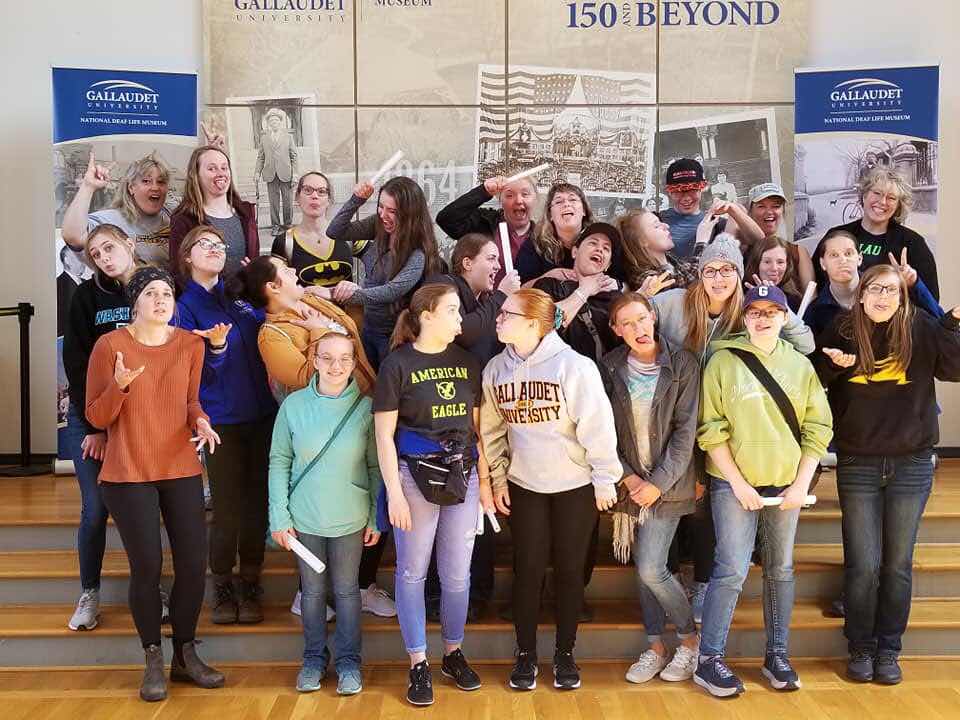
Signing for a week straight made me fall in love with the language, there is something special about communicating through your hands. As an introvert, I highly appreciated the silence and peace that surrounded our group wherever we went. We were by no means lacking in conversation, there were times when our hands didn’t seem to stop moving, but there was no ruckus of voices. I could easily become accustomed to this quiet. Whenever we went somewhere where we needed to use our voices for a moment, it was weird to speak again, and weird to hear the voices of the people around us. After I returned home, I felt myself wanting to sign to those around me all the time, wishing they would understand. How convenient and fun it would be, but I had to restrain myself as I know it would be confusing and pointless. I think if everyone could sign many things would be simpler and more peaceful.

Because of this experience, I believe I have discovered a new passion I did not before possess for this language, these people, and this place. I am excited to create future relationships with individuals who can sign and I have been inspired to do what I can to make a difference in the lives of those who are in need of interpretation services. This experience has changed me as a person, influenced my future, and given me memories and experiences that I will carry with me for the rest of my life.
Citations
Armstrong, David F. The History of Gallaudet University: 150 Years of a Deaf American Institution. Gallaudet University Press, 2014.
Sandler, Wendy. “The Body as Evidence for the Nature of Language.” Front. Psychol. 9:1782. 2008. doi: 10.3389/fpsyg.2018.01782
University of Sheffield. "Deaf adults see better than hearing people, new study finds." ScienceDaily. ScienceDaily, 11 November 2010. <www.sciencedaily.com/releases/2010/11/101110205051.htm>.

No comments:
Post a Comment